

Religious discrimination in the workplace occurs when an employer treats an employee or job applicant unfavorably because of their religion, religious beliefs, or religious practices. Under Title VII
of the Civil Rights Act of 1964, this treatment is illegal – regardless of whether the religion is widely practiced or not.
The U.S. Equal Employment Opportunity Commission (EEOC) received 3,640 religion-based discrimination charges in fiscal year 2024. While that figure reflects a drop from the pandemic-era spike of nearly 14,000 charges in 2022, religious discrimination in the workplace remains a significant and underreported issue across
American workplaces.
This guide covers the most common religious discrimination examples, what the law requires of employers, who is protected, and what steps to take if you have experienced religious bias at work in Florida.
What Is Religious Discrimination In The Workplace?
Religious discrimination in the workplace means treating an employee or applicant differently because of their religion or sincerely held religious beliefs. According to the EEOC, the law protects not only members of traditional organized religions — such as Christianity, Judaism, Islam, Hinduism, and Buddhism — but also individuals with sincerely held moral or ethical beliefs that function like religion.
Importantly, religious discrimination in the workplace also covers:
— Employees who have no religious beliefs (atheists and agnostics are equally protected under Title VII)
— Employees treated unfairly because of a family member’s religion (known as “associational discrimination”)
— Employees targeted because of religious dress or grooming practices — such as a hijab, yarmulke, Sikh turban, or Rastafarian dreadlocks
The law applies to every stage of employment — hiring, pay, promotions, scheduling, training, and termination.
Religious Accommodation In The Workplace
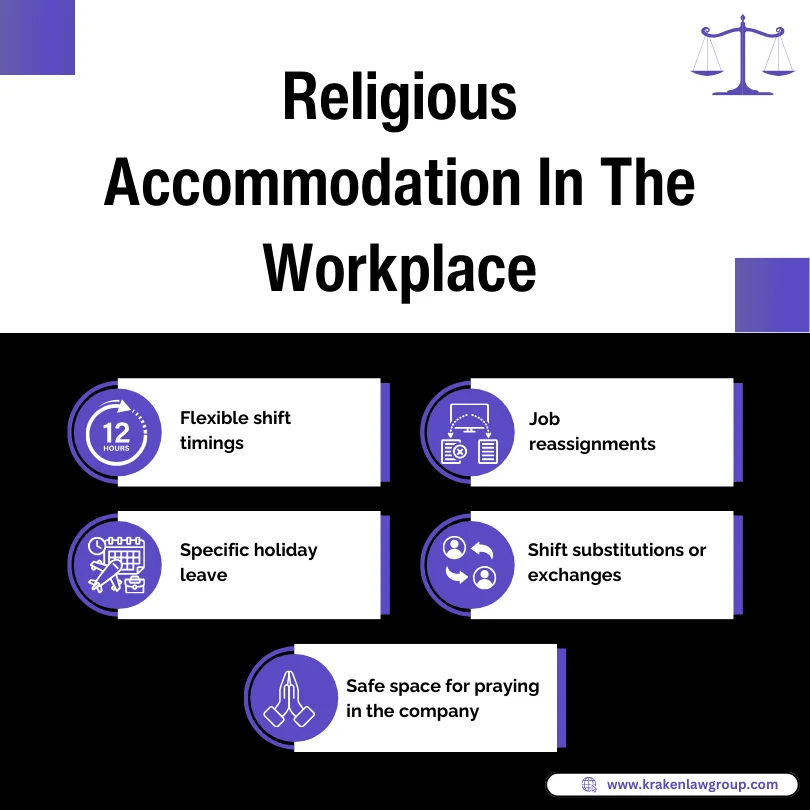
Under Title VII, employers are legally required to provide reasonable accommodations for an employee’s sincerely held religious beliefs — unless doing so would cause “undue hardship” to the business.
Following the U.S. Supreme Court’s landmark 2023 ruling in Groff v. DeJoy, the standard for what constitutes undue hardship was significantly strengthened in favor of employees. Employers can no longer deny an accommodation simply because it causes minor inconvenience. They must now demonstrate that the accommodation would result in substantial increased costs in the context of their overall business operations.
Common examples of reasonable religious accommodation in the workplace include:
— Flexible or modified work schedules for religious observances (Sabbath, Ramadan prayer times, religious holidays)
— Voluntary shift swaps or substitutions
— Job reassignments away from duties that conflict with religious beliefs
— Permission to wear religious dress or maintain religious grooming
— A designated space for prayer during breaks
If your employer has denied a religious accommodation request without demonstrating genuine undue hardship, that denial may constitute religious discrimination in the workplace.
Who Is Protected From Religious Discrimination In The Workplace?
Title VII of the Civil Rights Act protects all US citizens and foreigners working in the nation based on their religion in the workplace. Every employee at their company is protected under this law from religious discrimination examples.
Job applicants who apply at different companies also receive coverage under the law. This means companies cannot let their religious prejudice against specific applicants come in the way of offering them a job.
Any intern or person training in the workplace also receives protection from religious prejudice. This law protects those who believe in a specific religion and those who don’t believe in any religion.
This means that a Christian and an atheist are both protected under the Civil Rights Act in their workplace.
What The Data Says About Religious Prejudice At Work
Religious discrimination in the workplace is more common — and more costly — than many employees realize.
Key facts from EEOC and federal court data:
— The EEOC received 3,640 religion-based discrimination charges in FY 2024, down from a pandemic-era peak of nearly 14,000 charges in FY 2022
— The EEOC filed 11 religious discrimination lawsuits in FY 2025, reflecting renewed federal enforcement focus on protecting religious freedom at work
— In 2024, the EEOC recovered approximately $700 million for all discrimination victims — a 5% increase from 2023
— Columbia University agreed to pay $21 million in 2025 to settle EEOC charges of religious discrimination against Jewish employees following the October 7 Hamas attacks
— Pew Research Center surveys consistently show that Muslim Americans report among the highest rates of workplace discrimination based on religion
These figures reflect only formal EEOC charges. Religious discrimination in the workplace is widely understood to be underreported, as many employees fear retaliation or do not know their rights.
7 Common Religious Discrimination Examples in the Workplace
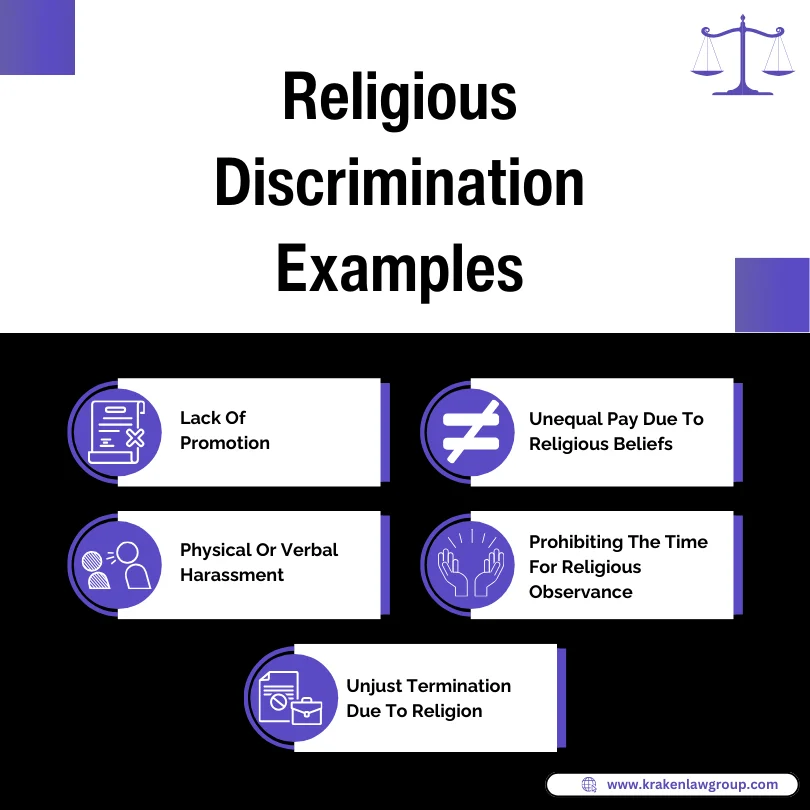
Let’s look at the top five religious discrimination examples in the workplace to help you understand this injustice better:
1. Denial of Promotion or Career Advancement
One of the most frequently reported religious discrimination
examples involves being passed over for promotions despite strong
performance. This may look like:
— A qualified Muslim employee repeatedly denied promotion while
less experienced colleagues advance
— An employer citing vague “culture fit” concerns that mask
religious bias
— Withholding training opportunities from employees of specific
faiths, ensuring they remain ineligible for senior roles
Under Title VII, employment decisions — including promotions —
cannot be influenced by an employee’s religion or religious
practices. If you have documented performance records that
contradict your employer’s stated reasons for denying promotion,
that discrepancy may be evidence of religious discrimination in
the workplace.
2. Unequal Pay or Benefits Based on Religion
Pay discrimination based on religion is illegal under Title VII.
This type of religious discrimination in the workplace may include:
— Lower base salaries for employees of minority religions compared
to equally or less qualified colleagues
— Exclusion from bonus programs, overtime opportunities, or
pension access
— Benefits structured in ways that disproportionately disadvantage
employees whose religious practices differ from the majority
This form of discrimination is often subtle and may require
comparing pay records across employees in similar roles to identify
a pattern. If you suspect pay discrimination based on religion,
documenting the disparity and consulting an employment attorney
promptly is important.
3. Harassment — Verbal or Physical
Religious harassment in the workplace is a recognized form of
religious discrimination under Title VII. It includes:
— Offensive remarks, slurs, or jokes targeting an employee’s
religion or religious practices
— Hostile comments about religious dress — such as a hijab,
turban, or yarmulke — from colleagues or supervisors
— Physical interference with religious articles or clothing
— A pattern of behavior that creates a hostile work environment
for employees of a specific faith
A single isolated comment may not always meet the legal threshold
for actionable harassment. However, repeated conduct that
unreasonably interferes with an employee’s ability to work — or
that a reasonable person would find hostile or abusive —
constitutes illegal religious harassment under federal law.
(EEOC, Section 12: Religious Discrimination)
4. Denial of Religious Accommodation
Following the Supreme Court’s ruling in Groff v. DeJoy (2023),
employers now face a higher legal bar when denying religious
accommodation requests. Denial of accommodation is one of the
most litigated religious discrimination examples in the workplace,
and may include:
— Refusing to adjust a work schedule for Sabbath observance,
Eid, Diwali, or other religious holidays
— Denying a dress or grooming accommodation — such as requiring
a Sikh employee to shave or a Muslim employee to remove a headscarf
— Scheduling mandatory meetings or events during an employee’s
established prayer times without offering alternatives
— Rejecting an accommodation request without conducting an
individualized assessment of whether undue hardship actually exists
In EEOC v. Houchens Food Group, the EEOC successfully sued an
employer that denied an applicant employment because the company
refused to accommodate his dreadlocks, which he maintained as
part of his religious beliefs. This case illustrates how
accommodation obligations extend even to the hiring stage.
5. Wrongful Termination Based on Religion
Terminating an employee because of their religion — or using
pretextual reasons to conceal religious bias — is among the most
serious religious discrimination examples recognized under
federal law. Signs of religiously motivated wrongful termination
include:
— Being fired shortly after an employer learns of your religion
or religious practices
— Termination citing “performance issues” that are inconsistent
with documented work history
— Position elimination followed by the creation of the same role
and hiring of a person of a different religion
— Constructive dismissal — where an employer makes conditions so
hostile that the employee is forced to resign
Florida is an at-will employment state, meaning employers can
generally terminate employees for any reason — except an illegal
one. Religious bias is an illegal reason. If you were terminated
and have reason to believe religion was a factor, you may have
grounds for a Title VII claim.
6. Religious Segregation or Unequal Job Assignments
Title VII explicitly prohibits workplace segregation based on
religion. This religious discrimination example includes:
— Assigning an employee to a back-office or non-customer-facing
role because of actual or anticipated customer bias against
their religion
— Excluding employees of specific faiths from client-facing
projects, presentations, or leadership opportunities
— Assigning heavier workloads, less desirable shifts, or
lower-visibility projects to employees of certain religious
backgrounds
In one EEOC guidance example, a supervisor allowed a Christian
employee to display a Bible on their desk but directed a Muslim
employee to hide their Quran — treating similarly situated
employees differently based solely on religion. That differential
treatment constitutes religious discrimination in the workplace.
7. Retaliation for Reporting Religious Discrimination
Retaliation is the most commonly cited charge in all EEOC filings.
When it follows a report of religious discrimination, it is
independently illegal under Title VII — even if the underlying
discrimination claim is ultimately not proven. Retaliation
examples include:
— Demotion, schedule changes, or pay cuts after filing an
internal complaint about religious bias
— Hostile treatment from supervisors or colleagues following
an EEOC charge
— Termination shortly after an employee raises a religious
accommodation request or discrimination complaint
— Being excluded from meetings, projects, or communications
after reporting religious harassment
If you reported religious discrimination in the workplace —
formally or informally — and subsequently experienced adverse
treatment, you may have an independent retaliation claim under
Title VII, separate from the original discrimination complaint.
Experienced Religious Discrimination at Work in Florida?
Talk to an Attorney.
Religious discrimination in the workplace is not always obvious.
It can be subtle — a pattern of overlooked promotions, a denied
schedule adjustment, a supervisor’s offhand comments that cross
the line. Whether the discrimination is direct or indirect,
employees in Florida have clear legal rights under both Title VII
and the Florida Civil Rights Act.
Kraken Law Group represents employees who have faced religious
discrimination in the workplace across Winter Park, Orlando, and
Central Florida. Our attorneys can review your situation, advise
you on whether you have grounds for an EEOC charge or civil
lawsuit, and help you pursue the compensation you deserve.
📞 Call 407-900-9055 or contact us online for a free consultation.
You pay nothing unless we win your case.
FAQs – Religious Discrimination in the Workplace
What are the most common religious discrimination examples in the workplace?
The most frequently reported religious discrimination examples include denial of reasonable accommodation (particularly around scheduling and religious dress), harassment based on religion, unequal pay or promotion opportunities, and wrongful termination. Following the Supreme Court’s 2023 ruling in Groff v. DeJoy, failure to provide religious accommodation is among the most actively litigated forms of religious discrimination in the workplace.
What is religious discrimination in the workplace?
Religious discrimination in the workplace is any unfavorable treatment of an employee or applicant based on their religion, religious beliefs, or religious practices. Under Title VII of the Civil Rights Act of 1964, this applies to all aspects of employment — hiring, pay, assignments, promotions, training, scheduling, and termination. It also covers employees targeted because of a family member’s religion or because they have no religious beliefs.
How Do You Talk About Religion In The Workplace?
You can talk about religion in the workplace by being mindful and respectful of different communities. Ask your colleagues if they want to talk on a specific topic or not.
Employers may also hold seminar sessions to enhance awareness and practices of their workers.
What Is An Example Of Religious Conflict In The Workplace?
One of the religious discrimination examples in the workplace includes a worker’s prayer hours conflicting with office hours. For instance, a company event may be held in the hours in which you must pray.
However, mandatory attendance at the event may hinder you from observing your religious practices.
Is religion a protected class under federal law?
Yes. Religion is a protected class under Title VII of the Civil Rights Act of 1964. Employers with 15 or more employees are prohibited from discriminating on the basis of religion. In Florida, the Florida Civil Rights Act provides additional parallel protections at the state level.
What qualifies as a “sincerely held religious belief” under the law? The EEOC takes a broad view. A sincerely held religious belief does not need to be part of a formal religion — it can include moral or ethical beliefs held with the same strength as traditional religious views. Courts do not evaluate whether a belief is “correct” or “logical” — only whether the person sincerely holds it. Notably, the belief must be religious in nature, not simply a personal preference.
What is the difference between religious discrimination and religious harassment?
Religious discrimination in the workplace refers to adverse employment actions — such as termination, pay cuts, or denied promotions — based on religion. Religious harassment involves unwelcome conduct based on religion that creates a hostile, intimidating, or offensive work environment. Both are illegal under Title VII. Harassment becomes actionable when it is severe or pervasive enough that a reasonable person would find it hostile or abusive.